
Barber County Criminal Court Records
A criminal court record is the court case file, not just the fact that an arrest happened. In Barber County, the Clerk of the District Court keeps district court case records once a criminal case is filed. The file may begin with a complaint or information, then grow as the court adds first appearance notes, bond orders, arraignment events, motions, hearing settings, pleas, trial activity, disposition, sentence, probation, costs, and restitution. The filed case record is where the court's official action is tracked.
Barber County District Court is the general-jurisdiction trial court for state criminal cases in the county. Medicine Lodge Municipal Court and Kiowa Municipal Court can handle city ordinance, traffic, and local misdemeanor ordinance matters. Kiowa's municipal page states that more serious criminal matters are handled through Barber County District Court. That distinction matters when a person cannot find a city citation in district court CaseSearch or when a municipal case later leads to a separate district court case.
For the narrower arrest-to-charge path, including how formal charges follow booking, use Barber County arrest records and court charges.
Search Barber County Criminal Records
Use Kansas CaseSearch for public Barber County criminal court records in district court. Search by defendant name or case number, then narrow by Barber County, case type, status, date, or judicial officer when those filters are available. The official Smart Search guide also shows citation number, attorney, business name, judicial officer, party name, and other search types. Some criminal documents may not be online even when the docket is public.
- Start with Kansas CaseSearch and enter the defendant name, case number, record number, or other supported search value.
- Use Barber County as the location filter to focus on the local district court case.
- Open Advanced Filtering Options to narrow by criminal case type, status, filing dates, or judicial officer.
- Read the docket entries for charges filed, arraignment, motions, plea, disposition, sentence, costs, and warrant events if public.
- Request copies or certified copies from the Clerk of the District Court when the needed public document is not available online.
The KBI criminal history search is a separate statewide criminal history route. It is useful for background record checks, but it is not the same as the Barber County criminal court file. A court file can show the case detail behind a local prosecution; a statewide history record is a separate product from the Kansas Bureau of Investigation.
The official KBI page is one statewide record source connected to criminal history rather than a court case file.
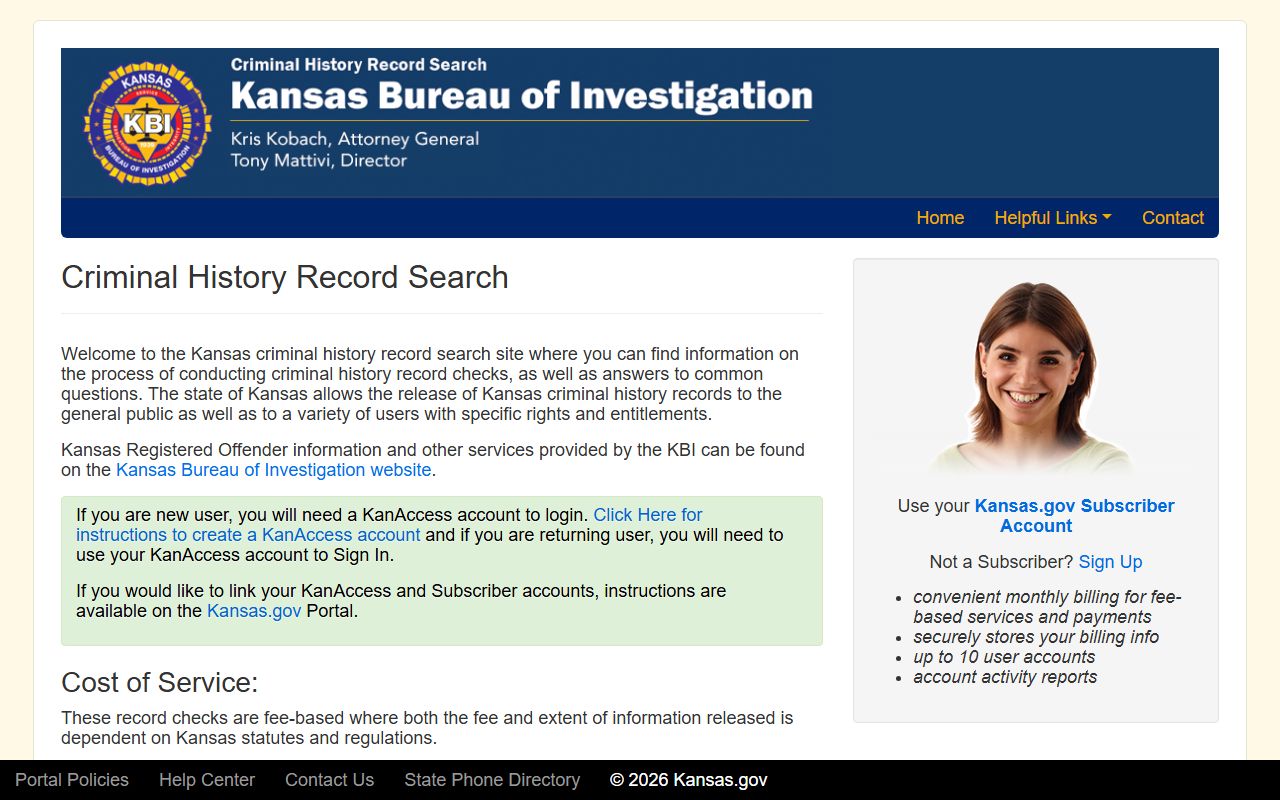
Use the statewide source to check criminal history, then use district court records to read the Barber County case itself.
Barber County Criminal Case Flow
A criminal case record changes as the case moves through court. Early entries may show the filed charge, bond, first appearance, and arraignment. Middle entries may show discovery, motions, continuances, plea negotiations, and hearing settings. Later entries may show a plea, verdict, dismissal, judgment, sentence, probation terms, restitution, court costs, or payment status. One case can have several counts, and each count can end in a different way.
Case flow: Charges Filed › Arraignment › Pretrial / Motions › Plea or Trial › Disposition › Sentencing
| Stage | What Happens |
|---|---|
| Charges filed | The prosecutor files a complaint or information, and the court opens or updates the criminal case. |
| Arraignment | The defendant is advised of the charge and enters a plea such as guilty or not guilty. |
| Pretrial / motions | The docket may show hearings, continuances, motions, orders, discovery disputes, or negotiations. |
| Plea or trial | The case resolves by plea, dismissal, trial verdict, acquittal, or other court action. |
| Disposition | The current or final outcome is entered for the case or for each count. |
| Sentencing | The court enters punishment, probation, jail or prison terms, fines, costs, restitution, or other conditions. |
The Kansas criminal history process page explains how statewide criminal record checks differ from case review.
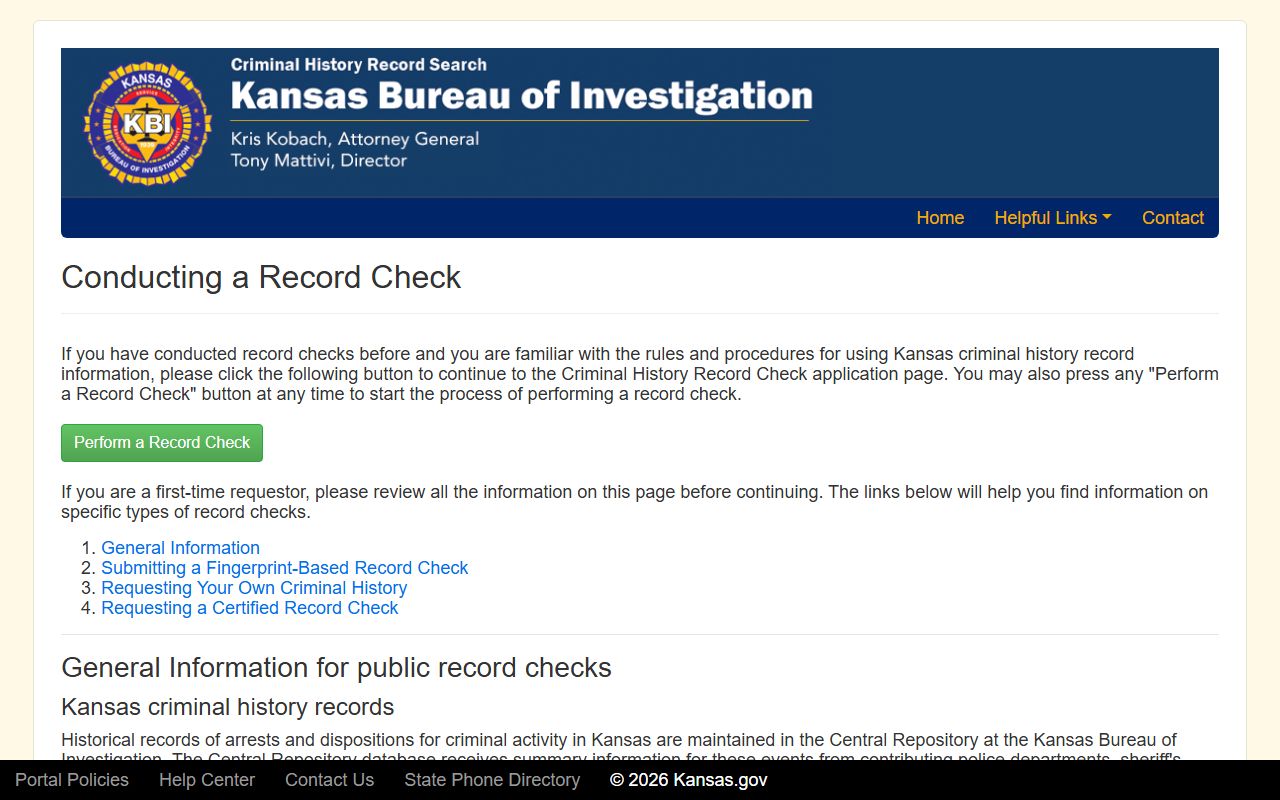
That distinction is useful when a CaseSearch docket shows detailed events but a background check summarizes criminal history differently.
Barber County Criminal Record Fields
Criminal court records can be read field by field. The caption identifies the State of Kansas and the defendant. The case number connects the file to the district court docket, payment systems, and copy requests. Charge entries identify each count, statute, severity level, and status. Docket entries show court events and filings. The disposition and sentence fields explain how the case or count ended and what the judge ordered.
| Field | What It Shows |
|---|---|
| Case number | The Barber County District Court identifier used for search, payment, and record requests. |
| Defendant | The person charged, with party role and attorney information when public. |
| Prosecutor | The State of Kansas or local prosecuting authority connected to the case. |
| Charges | The count number, charge description, statute, severity level, offense date, and status if public. |
| Bond | Bond amount, release terms, warrant status, or appearance conditions when entered and public. |
| Plea | The defendant's answer to a charge, such as guilty, not guilty, or another plea entry. |
| Disposition | The outcome of a case or count, including guilty, dismissed, acquitted, amended, or diverted if entered. |
| Sentence | Jail or prison terms, probation, fines, costs, restitution, and other court-ordered conditions. |
Barber County Charges vs Convictions
A charge is an accusation filed in court. A conviction is a final finding of guilt by plea or verdict. Barber County criminal court records can show charges that were later amended, reduced, dismissed, diverted, or resolved differently by count. That is why a record should be read all the way through the disposition and sentencing entries before drawing a conclusion from the first charge line.
| Charge | Conviction | |
|---|---|---|
| Stage | Filed allegation after arrest, citation, or complaint review | Final guilt finding by plea or verdict |
| Record use | Shows what the prosecutor alleged at that point | Shows the outcome used for sentencing and many background record purposes |
| Can change | May be amended, reduced, dismissed, or dropped | May later be appealed, set aside, sealed, or expunged when law allows |
| Where to verify | Docket charge list and charging document | Disposition, judgment, sentence, and final orders |
Barber County Criminal Prosecution
The Barber County Attorney is the local prosecutor office identified in the research. The County Attorney decides whether to file, amend, dismiss, or divert many state-law criminal charges in Barber County District Court. The county attorney page links diversion, bad-check, expungement, protection order, and forfeiture form resources. Diversion can affect the criminal court record because successful completion may prevent a conviction under the diversion agreement, while the case record may still show the filed case and diversion-related events.
Barber County Attorney
120 East Washington Avenue
Medicine Lodge, KS 67104
620-886-5646
Fax 620-886-5020
The county attorney page is the local source for diversion and expungement form links tied to criminal cases.
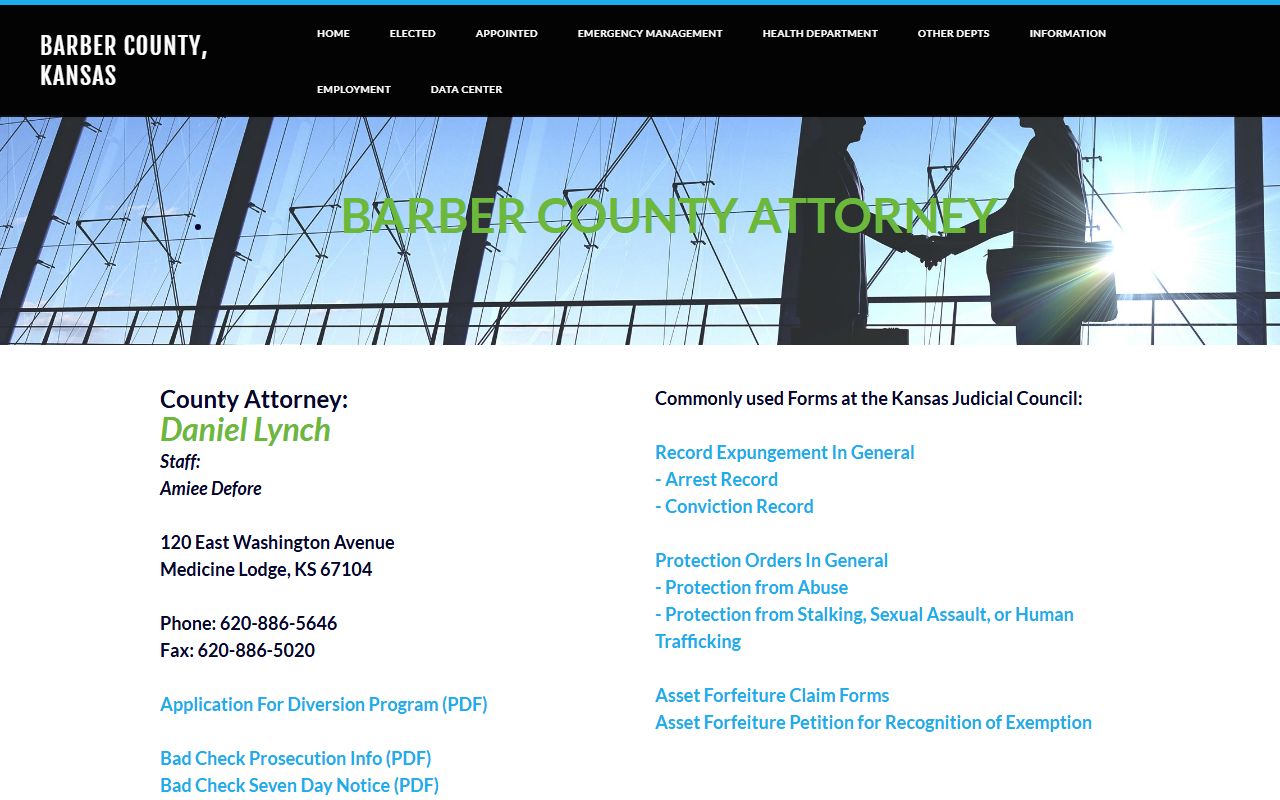
Those prosecutor resources help explain why a criminal docket may show diversion or amended charge activity before final disposition.
Barber County Criminal Records Channels
The court file is only one criminal record channel. The Sheriff is the local law-enforcement contact for county custody, booking, and warrant confirmation, while the District Court is the source for criminal case filings, docket status, hearings, bond orders, and bench warrant events. Kansas VINE can provide custody notification. KDOC KASPER is for state prison and supervision records. KBI criminal history is a statewide criminal history source, not a complete court case file.
The research did not locate an official Barber County online jail roster, sheriff warrant database, or sheriff records app. For custody or active local law-enforcement status, use the Sheriff's Office. For filed criminal case records, use CaseSearch, the courthouse terminal, or the Clerk of the District Court. For appointed felony defense counsel, Kansas State Board of Indigents' Defense Services is the state source, and a person should ask at first appearance or contact District Court about local assignment.
The official Barber County Sheriff page lists Sheriff Richard Garza and provides the local sheriff contact route.
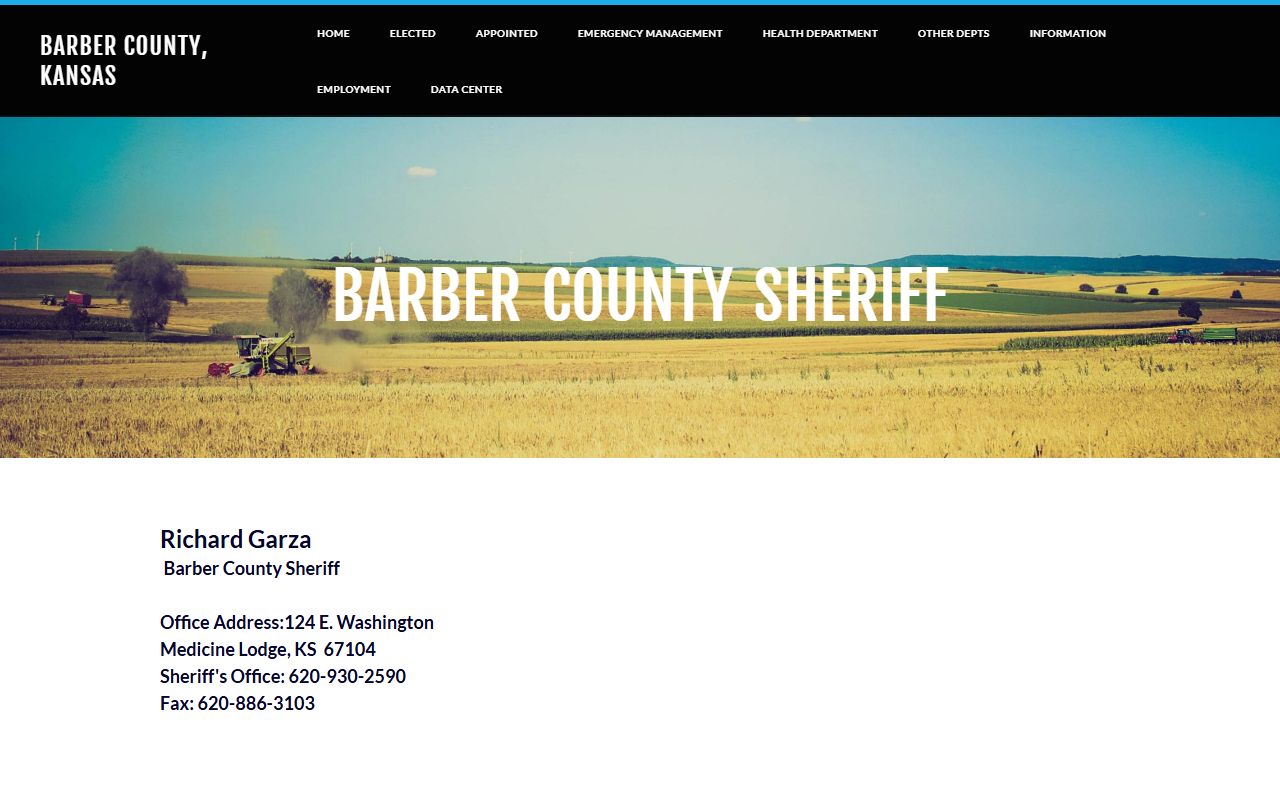
The sheriff contact is useful for custody and law-enforcement status, while criminal case filings remain with the court.
Sealed vs Expunged Criminal Records
Kansas treats sealing, redaction, and expungement as separate access concepts. Sealing or redaction under K.S.A. 60-2617 restricts access to a court record or proceeding by court order. Arrest record expungement is governed by K.S.A. 22-2410. Conviction expungement is governed by K.S.A. 21-6614. A granted expungement limits public access, but statutory users may still have access in certain circumstances.
| Sealed or Redacted | Expunged | |
|---|---|---|
| Core idea | Access is restricted or sensitive parts are masked by court order | Public access to an arrest or conviction record is limited after statutory requirements are met |
| Kansas source | K.S.A. 60-2617 | K.S.A. 22-2410 for arrest records; K.S.A. 21-6614 for many convictions |
| Where filed | The court connected to the record or proceeding | The district court connected to the arrest or conviction |
| Who may still see it | Depends on the order and law | Some law enforcement, licensing, immigration, or statutory users may still see it |
The Kansas arrest expungement statute is one source for restricting arrest record access.
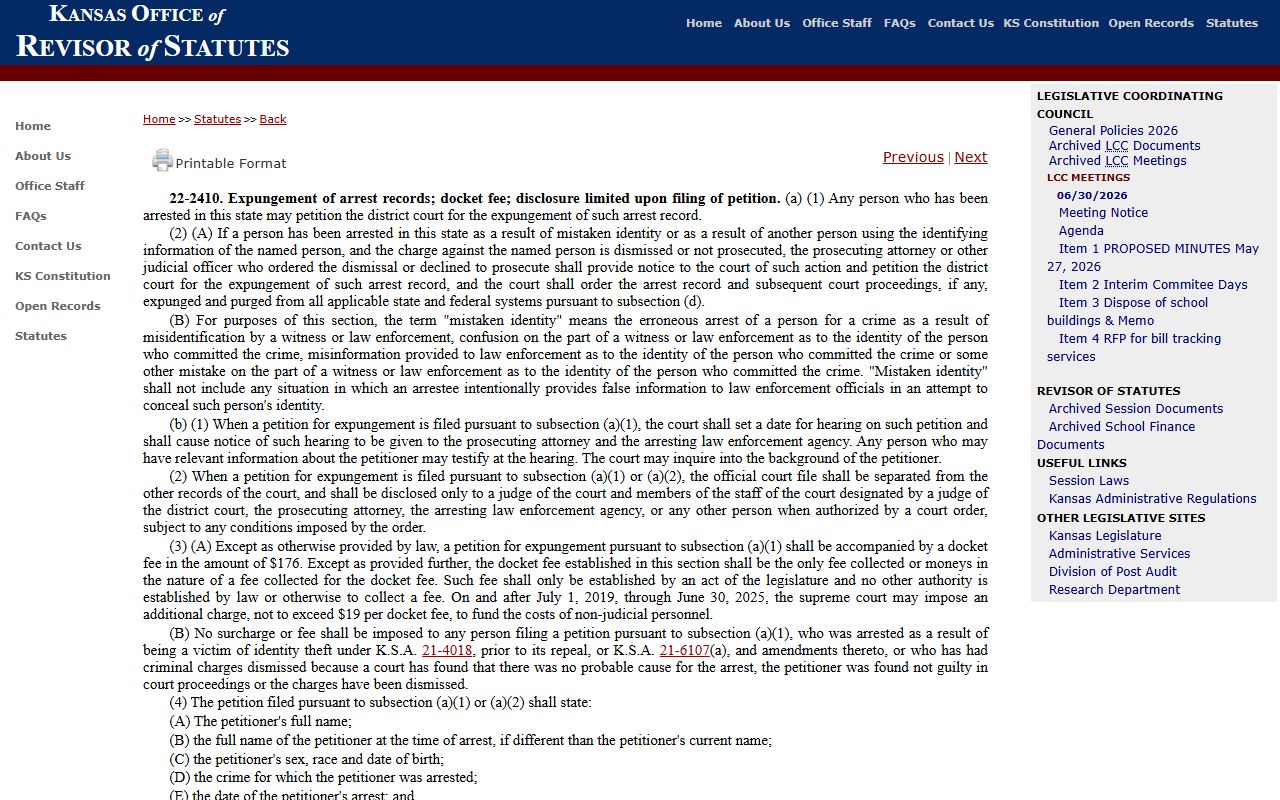
Arrest expungement should be kept separate from conviction expungement because the statutory route and record being restricted differ.
The Kansas conviction expungement statute governs many conviction record petitions.
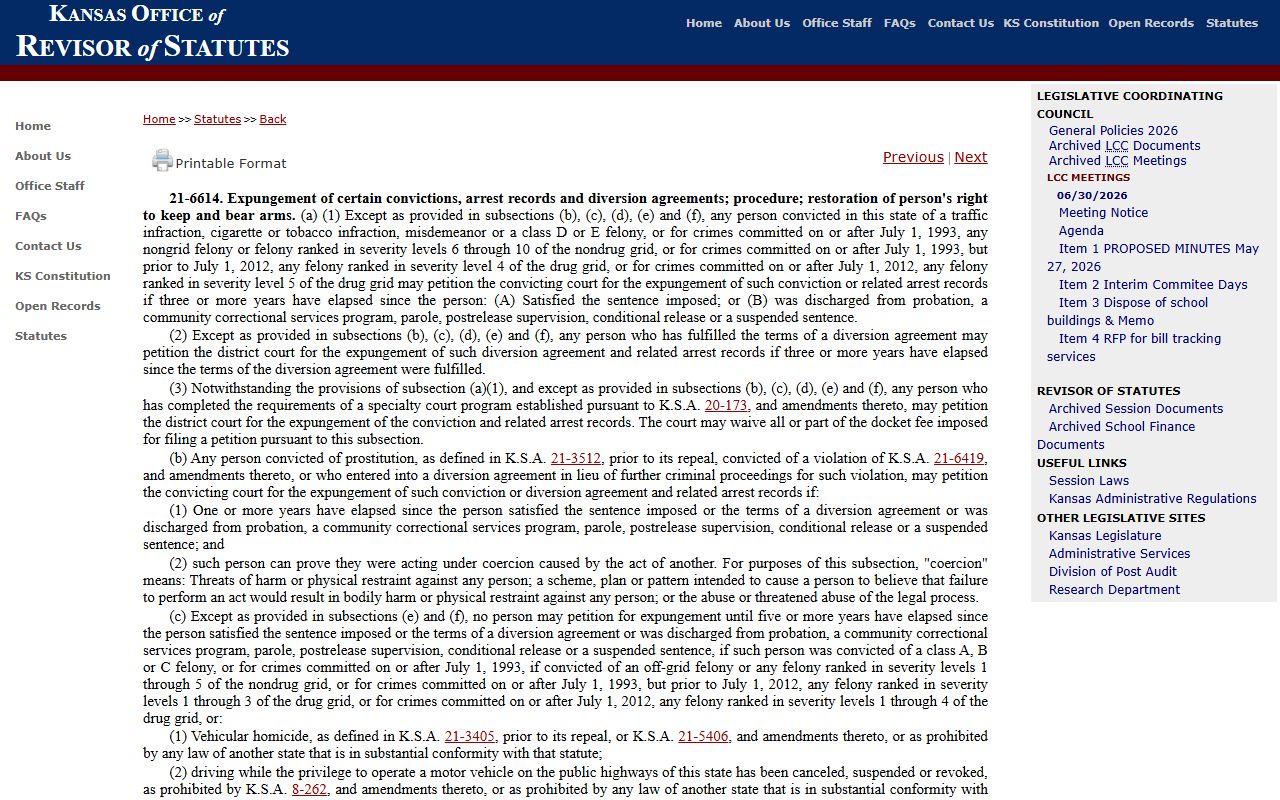
Conviction expungement is tied to the final outcome, so docket readers should confirm disposition and sentence before assessing eligibility.
Restricted Barber County Criminal Records
Not every criminal-related record is public online. Juvenile offender documents are not available through the public web portal. Search warrant case types are not public portal case types. Sealed or expunged records can be restricted. Personal identifiers are redacted under court rules. Active investigative material may be withheld by law-enforcement agencies. Protection and care or treatment categories have special limits and should not be treated as ordinary criminal docket content.
For a Barber County criminal court record that is public but not online, the practical route is the Clerk of the District Court at the Barber County Courthouse. Tina McCray is listed as Chief Clerk, and the office phone is 620-886-5639. The office hours listed in the research are 8:00 a.m. to noon and 1:00 p.m. to 4:00 p.m. A request should give the case number, defendant name, approximate filing year, requested document, and whether a certified copy is needed.
Note: A criminal charge entry should be read with the final disposition before it is treated as an outcome.